Wells and septic systems get most of the attention when buyers look at rural land. But another piece of due diligence can be just as important: the road you use to reach the property.
Just because you can drive to a property does not necessarily mean the access questions are settled.
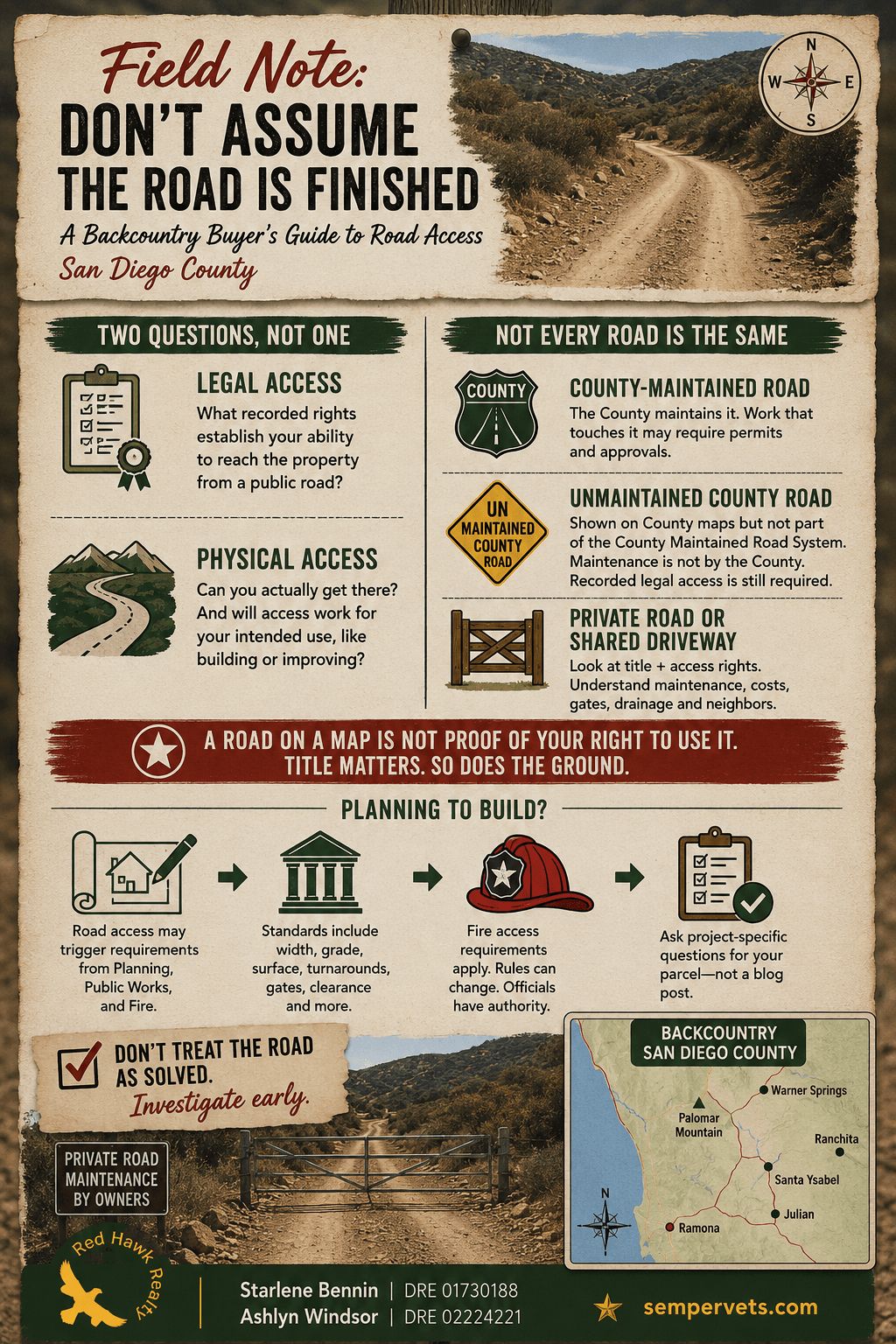
The first thing to understand is that legal access and physical access are two different things.
As brokers, our role is to identify these issues early, help buyers gather the relevant information, and help you direct project-specific legal, title, permitting and fire questions to the appropriate professionals and agencies.
Two Questions, Not One
Legal access and physical access are not the same thing. A parcel can have one without the other.
Legal access is the paper. What recorded rights establish your ability to reach the property from a public road?
Physical access is the ground. Can you actually get there? And if you plan to build or substantially improve the property, will the existing access work for the project you have in mind?
There's a third layer if you plan to build: development access, whether the road will satisfy what's required for that specific project. We'll come back to that later. For now, the foundation is understanding legal access and physical access.
The road can feel perfectly fine when you drive it on a Saturday afternoon and still have an access problem buried in the title work. Or the legal access can be there while the physical road itself creates questions about grading, drainage, maintenance, gates, emergency access or future development.
If your parcel fronts a public road, the situation may be relatively straightforward. The questions often start when you turn off that road onto whatever gets you the rest of the way to the property.
That is where we start paying close attention to the paper.
Not Every Road Is the Same
A County-maintained road
Some roads are part of San Diego County's maintained road system. The County is responsible for maintaining those roads.
That does not mean an owner can simply alter the road or the County right-of-way.
The right-of-way is the strip of land the County holds the rights to for that road. Work involving a new driveway connection, drainage or other improvements may require County review and permits.
A road that isn't County-maintained
This category deserves some care because not every road shown on a map is a County-maintained road.
Our own road is a good example. Grapevine Canyon Road in Ranchita includes what San Diego County identifies as a "Z" road. The County explains that Z roads originated from roads or trails shown on historic highway-planning maps. They are not part of the County Maintained Road System, and their appearance on a County map should not be treated as proof that the County has established a legal public right-of-way.
That distinction matters.
A road can physically exist. People may have driven it for decades. It can have a name. It can even appear on government mapping.
None of those things, by themselves, answer the title question for the parcel you are buying.
That is why we still want to know what the title work says about your right to use the road.
What we are looking for is a recorded easement: a legal right for your property to cross land that belongs to someone else.
A private road or shared driveway
Here we look closely at both access and maintenance.
What does title show? Is there a recorded easement? What property does it cross? Are there restrictions on its use? Is there a recorded road-maintenance agreement?
Then there is the question title doesn't always answer: who actually takes care of the road?
Who grades it after winter?
Who clears a fallen tree?
Who repairs drainage?
Who pays when the road suddenly needs $8,000 worth of work?
Sometimes there is a recorded agreement. Sometimes there is an informal group of neighbors who have handled it together for decades. Neither situation should automatically make or break a purchase, but a buyer should know which one they are buying into.
What We Look At, and When
We don't necessarily resolve every access question before a buyer makes an offer. The detailed work happens during the buyer's investigation period, when we start working through it on paper and on the ground.
That period is the window your contract sets aside to look into the property before you are committed.
We ask for the preliminary title report and, when appropriate, plotted easements, so we can see what recorded documents affect access. We read the title exceptions and look for recorded easements, restrictions and maintenance obligations.
The exceptions are the items the title company is flagging as excluded from its coverage. They are worth reading closely.
If there isn't a written road-maintenance agreement, that is not automatically a red flag. It is common in parts of the backcountry, including Ranchita.
It is something to understand and evaluate.
Unclear or missing legal access is a much bigger question.
When appropriate, we drive or walk the road. We work with the title company. We help the buyer identify questions that need to go to Planning or the applicable fire authority before the buyer assumes a particular project will work.
What we do not do is give a legal opinion that an easement is sufficient.
If the paper looks thin, confusing or contradictory, we say so and recommend that the buyer speak with a qualified real-estate attorney. That legal analysis belongs between the buyer and the attorney.
And if something significant surfaces during investigations and more time is needed, we can discuss whether it makes sense to request extra time in that investigation window.
The important part is doing this work early, while the buyer still has room to investigate and make decisions.
If You Plan to Build
A road that works for the property's current use may not necessarily satisfy the requirements for what you want to build.
When someone wants to build or substantially improve a property, Planning, Public Works and the applicable fire authority may all have something to say about access.
San Diego County has standards for public and private roads. Fire regulations address fire-apparatus access, including things such as road width, grade, surface, clearance, turnarounds, gates and other conditions.
Those documents contain actual measurements and technical standards.
We intentionally are not reproducing those numbers here.
Why?
Because a blog post should not become your project's permit checklist.
Requirements can change. Different types of projects can trigger different requirements. The fire code official has authority in applying fire-access requirements. A single-family building permit is not necessarily treated the same way as a subdivision or other development.
We have seen this firsthand. In the Ranchita area, we have seen homes permitted in recent years with substantial stretches of unmaintained dirt-road access, without requiring expensive road improvements first. That is useful context when helping buyers identify the right questions to ask. It is not precedent. What happened on one Ranchita parcel is not a promise about what will happen on the parcel next door.
We have also seen road access become the expensive surprise later in a project. That is why we will not look at a listing photograph, see a dirt road and tell a buyer:
"You're fine. You can build."
We don't know that yet.
Treat the Road Like the Well and Septic
If you're buying rural land with plans to build, don't assume the road is the part that's already been figured out simply because you drove it to the property.
Look at the paper. Look at the ground. Understand who maintains the road and who pays for it. And if you're planning to build or substantially improve the property, take the project-specific access questions to Planning and the applicable fire authority early in your investigation.
Our job isn't to tell you, "You're fine. You can build."
Our job is to recognize the question early, help you gather the information, and get that question in front of the person qualified to answer it. That way, you still have time to make an informed decision.
If You're Looking
If you're exploring backcountry property in San Diego County (Ranchita, Santa Ysabel, Warner Springs, Julian, Palomar, Ramona or the surrounding areas), we're happy to look at the road with you.
We'll help you review what is on paper, look at what is on the ground, and tell you when the next question belongs with title, the County, fire or an attorney.
Because in the backcountry, being able to get to a property and having the legal and practical right to keep getting there aren't always the same thing.